Health Tech2026.05.14
The 510(k) Loophole: How AI Medical Devices Skip the Scrutiny They Need
검증 없이 병원에 들어온 AI — FDA 510(k)의 맹점
읽기 도움말Intro
A Warning You Can't Verify
확인할 수 없는 경고
Imagine you are admitted to a hospital and, within hours, a screen at the nurses' station lights up with an alert: the AI says you are at high risk for sepsis. What you don't know — and what the hospital may not openly disclose — is whether that algorithm was ever validated before it was deployed on your floor.
병원에 입원한 지 몇 시간도 되지 않아 간호사실 모니터에 경고가 뜬다고 상상해 보세요. AI가 패혈증 고위험군이라고 알린 거예요. 하지만 여러분이 아마 모르는 사실이 있어요. 그 알고리즘이 정말로 독립적인 검증을 거쳤는지, 병원도 쉽게 말해주지 않는다는 거예요.
What's new
The Approval Path That Asks the Least
가장 적게 묻는 승인 경로
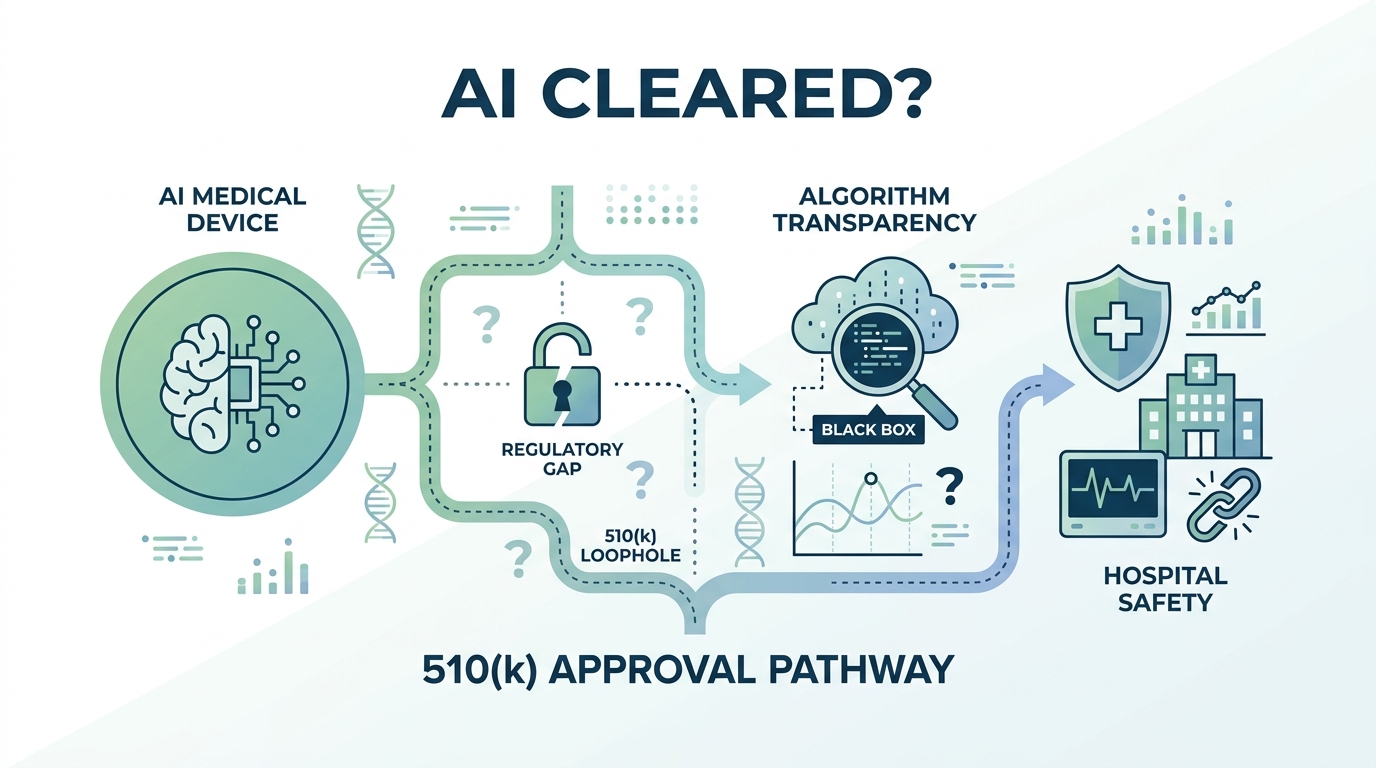
A recent STAT News investigation exposed what many in the field have quietly known: the vast majority of AI medical devices reach the U.S. market through the FDA's 510(k) clearance pathway, a route that does not require new clinical trial data. Under 510(k), a manufacturer only needs to demonstrate substantial equivalence — meaning their new device is "substantially equivalent" to a product that already exists on the market. The problem is that this framework was designed for physical devices like catheters and surgical instruments — not for software that learns, adapts, and changes its behavior after deployment.
최근 STAT 뉴스의 조사는 업계에서 조용히 알고 있던 사실을 수면 위로 끌어올렸어요. 대부분의 AI 의료기기가 FDA의 510(k) 허가 경로를 통해 시장에 나오는데, 이 경로에선 새로운 임상 데이터가 필요 없어요. 510(k) 기준에서 제조사는 실질적 동등성만 증명하면 돼요. 이미 시장에 있는 제품과 '실질적으로 동등하다'는 것만 보여주면 되는 거예요. 문제는 이 체계가 카테터나 수술 기구처럼 물리적인 의료기기를 위해 설계됐다는 거예요. 배포 후에도 스스로 학습하고 변화하는 소프트웨어엔 맞지 않아요.
Why it matters
When an Algorithm Drifts, Nobody Catches It
알고리즘이 변해도 아무도 모르는 이유
Here is where the risk becomes real: many AI systems are adaptive algorithms, meaning they keep learning from new data even after they receive clearance. Over time, the model's behavior can shift significantly from what was originally tested — a phenomenon researchers call algorithm drift. The STAT report highlighted sepsis prediction tools as a case in point: dozens of U.S. hospitals are using the same commercially available algorithm, yet few have conducted their own independent validation to confirm it actually works in their specific patient population.
이 지점에서 위험이 현실이 돼요. 많은 AI 시스템은 적응형 알고리즘이에요. 허가를 받은 이후에도 새 데이터로 계속 학습하거든요. 시간이 흐르면 모델의 동작 방식이 처음 검증했을 때와 크게 달라질 수 있어요. 연구자들은 이 현상을 알고리즘 드리프트라고 불러요. STAT 보고서는 패혈증 예측 도구를 대표적인 사례로 꼽았어요. 미국의 수십 개 병원이 동일한 상용 알고리즘을 쓰고 있지만, 독립 검증을 직접 수행한 곳은 소수에 불과해요.
Context
A Gap That Exists in Korea Too
한국도 예외가 아니에요
This is not just an American problem — it is a regulatory challenge that every country adopting AI diagnostics must confront. South Korea's Ministry of Food and Drug Safety updated its Software as a Medical Device guidelines in 2025, tightening classification rules for AI diagnostics, but clear requirements for post-market algorithm update reviews remain limited. As AI diagnostic software spreads rapidly into Korean hospitals — from skin cancer detection to chest X-ray reading — the question of ongoing oversight is becoming urgent. Korea's Ministry of Food and Drug Safety has begun developing its own AI medical device certification standards, but critics argue the process moves too slowly relative to deployment pace — a concern echoed by patient advocacy groups who warn that approval gaps expose patients to inadequate risk disclosure.
이 문제는 미국만의 이야기가 아니에요. AI 진단 기술을 도입하는 모든 나라가 마주해야 할 규제 과제예요. 한국 식약처는 2025년에 의료기기 소프트웨어(SaMD) 가이드라인을 개정해 AI 진단 분류를 강화했어요. 하지만 시판 후 알고리즘 업데이트에 대한 명확한 재심사 기준은 아직 부족해요. AI 진단 소프트웨어가 피부암 감지부터 흉부 X레이 판독까지 국내 병원에 빠르게 퍼지고 있는 지금, 지속적인 감시 체계가 시급한 문제로 떠오르고 있어요. 한국 식품의약품안전처는 자체적인 AI 의료기기 인증 기준을 개발하기 시작했지만, 비평가들은 도입 속도에 비해 과정이 너무 느리다고 주장해요. 승인 격차가 환자를 불충분한 위험 고지에 노출시킨다고 경고하는 환자 옹호 단체들의 우려와 맥을 같이해요.
Patient action
Questions Worth Asking Before You Trust the Machine
AI를 믿기 전에 물어볼 것들
Neither patients nor clinicians should simply accept the word "FDA-cleared" as proof that an AI tool is safe and effective in their specific context. Practical questions to ask: When was this algorithm last externally validated? Has it been tested on patients like me? What happens when its performance drops below a threshold? Before your next procedure involving an AI-assisted diagnostic tool, ask your doctor whether the algorithm has been validated on patients with your specific background — because when an algorithm fails silently, the stakes are measured in patient lives, not data points.
환자도, 의료진도 'FDA 허가'라는 말 하나만으로 AI 도구가 자신의 상황에서도 안전하고 효과적이라고 받아들이면 안 돼요. 실질적으로 물어볼 수 있는 질문들이 있어요. 이 알고리즘은 언제 외부 검증을 받았나요? 저와 비슷한 환자에게 테스트됐나요? 성능이 떨어지면 어떻게 되나요? 규제 기관과 병원 모두가 이 질문들에 투명하게 답해야 할 책임이 있어요. 알고리즘이 조용히 실패할 때 그 대가는 데이터 포인트가 아니라 환자의 생명으로 측정되니까요.
이 칼럼이 마음에 드셨나요?
새 칼럼이 발행되면 영문 + 한글 본문을 통째로 메일로 보내드려요. 매일 아침, 광고 없이.
언제든 한 번에 해지할 수 있어요.