AI Trend2026.05.17
ArXiv's One-Year Ban: What Happens When AI Writes Your Research Paper
ArXiv 1년 정지 정책: AI가 논문을 대신 쓰면 생기는 일
읽기 도움말The New Rule
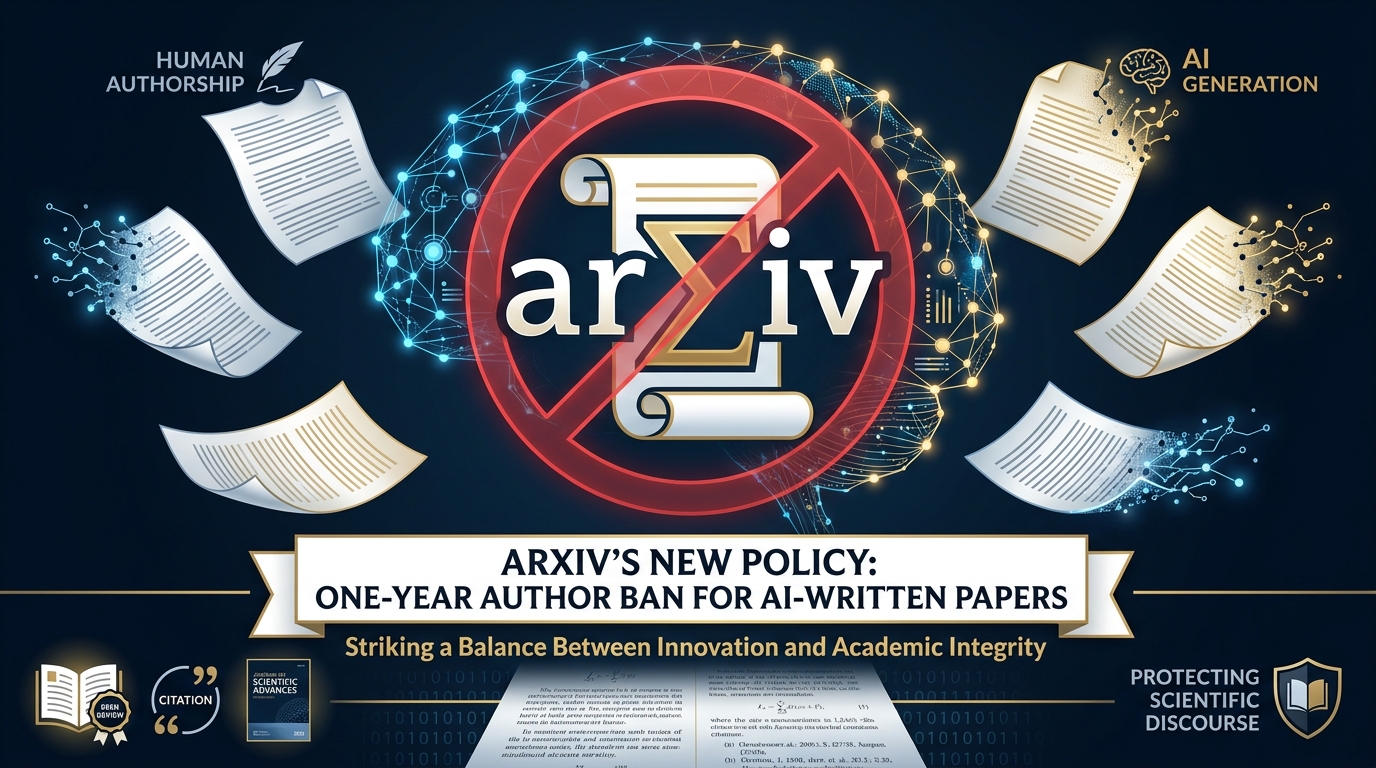
Imagine spending weeks crafting a research paper — or imagine asking ChatGPT to write the whole thing in an afternoon. ArXiv, the world's most influential scientific server, has just decided those two scenarios are not equally acceptable. On May 16, 2026, ArXiv announced a significant policy change: authors who submit papers in which AI has generated the core intellectual content — rather than simply helping with editing or formatting — will face a one-year submission ban from the platform. This makes ArXiv one of the first major academic institutions to attach a concrete, multi-month penalty — not just a warning or a retraction — to the misuse of generative AI in research. ArXiv hosts roughly two million papers across physics, mathematics, computer science, biology, and economics — and receives more than 10,000 new submissions every day. That scale makes the integrity of its collection critically important.
몇 주를 들여 논문을 쓰는 경우를 상상해보세요. 또는 ChatGPT에게 오후 한나절 만에 논문 전체를 써달라고 하는 경우를 상상해보세요. 세계에서 가장 영향력 있는 과학 프리프린트 서버인 ArXiv는 이 두 시나리오가 동등하게 허용되어서는 안 된다고 결정했어요. 2026년 5월 16일, ArXiv는 중요한 정책 변경을 발표했어요. AI가 단순히 편집이나 형식 다듬기를 도운 게 아니라 핵심 지적 내용을 생성한 논문을 제출한 저자는 플랫폼에서 1년간 제출 금지 처분을 받게 돼요. 이로써 ArXiv는 연구에서 생성형 AI를 오용하는 것에 경고나 취소 조치가 아닌 구체적이고 수개월에 걸친 처벌을 부과하는 최초의 주요 학술 기관 중 하나가 됐어요. ArXiv는 물리학, 수학, 컴퓨터 과학, 생물학, 경제학 분야의 약 200만 편의 논문을 보유하고 있으며, 매일 10,000건 이상의 새로운 프리프린트 논문을 접수해요. 그 규모 때문에 컬렉션의 무결성은 매우 중요해요.
Why ArXiv Drew the Line
The trigger for this policy was a measurable surge in AI-generated content flooding servers throughout 2025 and early 2026. Reviewers noticed a new pattern: papers with suspiciously smooth prose, generic conclusions, and — most alarmingly — hallucinated citations that referenced studies that did not exist. A hallucinated citation is not a small problem. When a fabricated reference makes its way into a , other researchers may build on it, cite it themselves, and unknowingly pass the error down through the scientific literature — a phenomenon sometimes called citation laundering. ArXiv's moderators — volunteers who screen incoming papers for relevance and basic scientific quality — reported that the volume of flagged submissions doubled between 2024 and 2025, straining a system that was already operating under pressure. The core concern is not efficiency — AI can certainly write faster than humans. The concern is . Science advances because researchers stake their professional reputations on the claims they make. An AI has no reputation to stake. ArXiv's policy statement puts it plainly: "The scientific record depends on human intellectual authorship. We are not anti-AI tools. We are pro-accountability."
이 정책의 계기는 2025년과 2026년 초 프리프린트 서버에 AI 생성 콘텐츠가 쏟아지는 측정 가능한 급증이었어요. 심사자들은 새로운 패턴을 발견했어요. 의심스러울 만큼 매끄러운 문체, 일반적인 결론, 그리고 가장 심각하게는 존재하지 않는 연구를 인용하는 환각 인용이 있는 논문들이었어요. 환각 인용은 사소한 문제가 아니에요. 허위 참고문헌이 프리프린트에 들어가면 다른 연구자들이 그것을 기반으로 연구하고, 스스로 인용하고, 자신도 모르게 오류를 과학 문헌으로 전달할 수 있어요. 이 현상을 인용 세탁이라고 부르기도 해요. ArXiv의 조정자들, 즉 접수된 논문을 관련성과 기본 과학적 품질 기준으로 검토하는 자원봉사자들은 2024년에서 2025년 사이 표시된 제출 건수가 두 배로 늘었다고 보고했어요. 이미 압박 속에 운영되던 시스템에 더 큰 부담을 준 거예요. 핵심 우려는 효율성이 아니에요. AI가 인간보다 빠르게 쓸 수 있는 건 분명하니까요. 우려는 책임이에요. 과학은 연구자들이 자신의 주장에 전문적 명성을 걸기 때문에 발전해요. AI는 걸어야 할 명성이 없어요. ArXiv의 정책 성명은 명확하게 표현하고 있어요. "과학 기록은 인간의 지적 저작에 의존합니다. 우리는 AI 도구를 반대하는 게 아니에요. 우리는 책임을 지지하는 겁니다."
What "AI-Written" Actually Means
The hardest part of this policy is drawing a clear line. Almost every researcher today uses AI in some way — for grammar checks, literature searches, data visualization, or code generation. None of that is banned. What is banned is ghostwriting by AI: using a language model to generate the hypothesis, the analysis, or the conclusions of the paper — the parts that represent the author's original intellectual contribution. ArXiv is asking authors to self-declare their use of AI tools in a new disclosure statement section. Misrepresentation — claiming you wrote something that AI generated — is what triggers the ban, not merely using AI as a research assistant. Detection is still imperfect. AI-detection tools like GPTZero or Turnitin's AI detector can identify statistical patterns typical of language models, but they produce false positives — flagging human-written text as AI-generated — at rates that worry researchers. ArXiv says its moderation process will rely primarily on human judgment — experienced reviewers reading for telltale signs — and on reports from the community rather than purely automated flagging.
이 정책의 가장 어려운 부분은 명확한 경계선을 긋는 거예요. 오늘날 거의 모든 연구자가 어떤 방식으로든 AI를 사용해요. 문법 검사, 문헌 검색, 데이터 시각화, 코드 생성 등에요. 이것들은 모두 금지 대상이 아니에요. 금지되는 것은 AI 대필이에요. 논문의 가설, 분석 또는 결론, 즉 저자의 독창적인 지적 기여를 나타내는 부분을 생성하는 데 언어 모델을 사용하는 거예요. ArXiv는 저자들에게 새로운 공개 진술 섹션에서 AI 도구 사용을 자체 신고하도록 요청하고 있어요. 처벌을 유발하는 것은 단순히 AI를 연구 보조로 사용하는 게 아니라, AI가 생성한 것을 자신이 썼다고 잘못 표현하는 거예요. 탐지는 아직 완벽하지 않아요. GPTZero나 Turnitin의 AI 탐지기 같은 도구들은 언어 모델에 전형적인 통계 패턴을 식별할 수 있지만, 연구자들이 우려할 수준의 오탐지율로 인간이 작성한 텍스트를 AI 생성으로 표시하기도 해요. ArXiv는 조정 과정이 주로 인간의 판단에 의존할 것이라고 말해요. 징후를 읽는 경험 많은 심사자들의 검토와, 순전히 자동화된 표시보다는 커뮤니티의 신고에 의존하는 거예요.
The Bigger Debate
Not everyone agrees that a one-year ban is the right response. Some researchers argue that the problem is not AI authorship per se, but rather the lack of transparency — and that mandatory disclosure would solve the problem without punishing legitimate users. Others argue the policy does not go far enough. If an AI model generates a hypothesis that turns out to be false, and a real person publishes it under their name, that person may face academic misconduct charges — but the company whose model produced the flawed idea faces nothing. This asymmetry — where human researchers bear all the risk while AI systems bear none — is increasingly being called the gap, and it is showing up not just in academia, but in journalism, law, and medicine too. The ArXiv policy will almost certainly be watched closely by journals like Nature, Science, and The Lancet, which have been navigating their own AI policies since 2023 — and by universities trying to establish academic integrity standards for the AI era.
모든 사람이 1년 정지가 올바른 대응이라고 동의하는 건 아니에요. 일부 연구자들은 문제가 AI 저작 자체가 아니라 투명성 부족이며, 의무적인 공개만으로도 정당한 사용자를 처벌하지 않고 문제를 해결할 수 있다고 주장해요. 정책이 충분하지 않다고 주장하는 사람들도 있어요. AI 모델이 잘못된 것으로 판명된 가설을 생성하고, 실제 사람이 자신의 이름으로 그것을 발표한다면, 그 사람은 학문적 비위 혐의에 직면할 수 있어요. 하지만 결함 있는 아이디어를 생성한 모델의 회사는 아무런 책임을 지지 않아요. 인간 연구자들이 모든 위험을 부담하는 반면 AI 시스템은 아무것도 부담하지 않는 이 비대칭성은 점점 더 책임 공백이라고 불리고 있으며, 이는 학계뿐만 아니라 저널리즘, 법률, 의료계에서도 나타나고 있어요. ArXiv 정책은 2023년부터 자체 AI 정책을 마련해온 Nature, Science, The Lancet 같은 저널들과, AI 시대의 학문적 성실성 기준을 수립하려는 대학들이 면밀히 지켜볼 것이 거의 확실해요.
What you can do
If you are a student or researcher, the practical takeaway is simple: using AI to improve your writing is acceptable, but having AI generate the ideas and conclusions is not — and the paper trails are getting harder to hide. For the broader public, this matters because scientific literature is the foundation of the medical guidelines you follow, the policy decisions your government makes, and the technology products that reach your hands. If AI quietly corrupts that foundation, the effects ripple far beyond academia. There is also a more philosophical question embedded in this policy: what do we actually value when we value human-authored research? Is it the quality of the output — the correctness of the results? Or is it the process of human thinking, with all its struggle and uncertainty, that gives science its meaning? As you read scientific papers or research reports, authorship now matters as much as findings: whether AI the structure or a human did changes what you should treat as a credible claim versus a generated summary worth verifying .
학생이거나 연구자라면 실질적인 교훈은 간단해요. AI를 사용해 글을 개선하는 것은 허용되지만, AI가 아이디어와 결론을 생성하게 하는 것은 허용되지 않아요. 그리고 그 흔적은 점점 더 숨기기 어려워지고 있어요. 더 넓은 대중에게 이 논쟁이 중요한 이유는 과학 문헌이 여러분이 따르는 의료 지침, 정부가 내리는 정책 결정, 그리고 여러분의 손에 닿는 기술 제품들의 기반이기 때문이에요. AI가 조용히 그 기반을 훼손한다면, 그 영향은 학계를 훨씬 넘어서까지 파급돼요. 이 정책에는 더 철학적인 질문도 담겨 있어요. 인간이 저술한 연구를 가치 있게 여길 때 우리가 실제로 소중히 여기는 게 뭘까요? 결과물의 품질, 즉 결과의 정확성일까요? 아니면 모든 고투와 불확실성을 가진 인간적 사고 과정이 과학에 의미를 부여하는 걸까요? 논문이나 연구 보고서를 읽을 때, 작성 방식에 관한 저작 문제는 이제 연구 결과만큼이나 여러분에게 중요해요. AI가 구조를 잡았는지, 사람이 썼는지에 따라 신뢰할 주장인지 아니면 독립적으로 검증할 생성 요약인지가 달라지거든요.
이 칼럼이 마음에 드셨나요?
새 칼럼이 발행되면 영문 + 한글 본문을 통째로 메일로 보내드려요. 매일 아침, 광고 없이.
언제든 한 번에 해지할 수 있어요.