Business2026.05.10
China's Exports Surge 14% Despite US Tariffs — What It Signals Before the Xi-Trump Summit
미국 관세에도 중국 수출 14% 급증 — 시진핑-트럼프 정상회담 전 무역 역학 해설
읽기 도움말Tariffs That Didn't Work
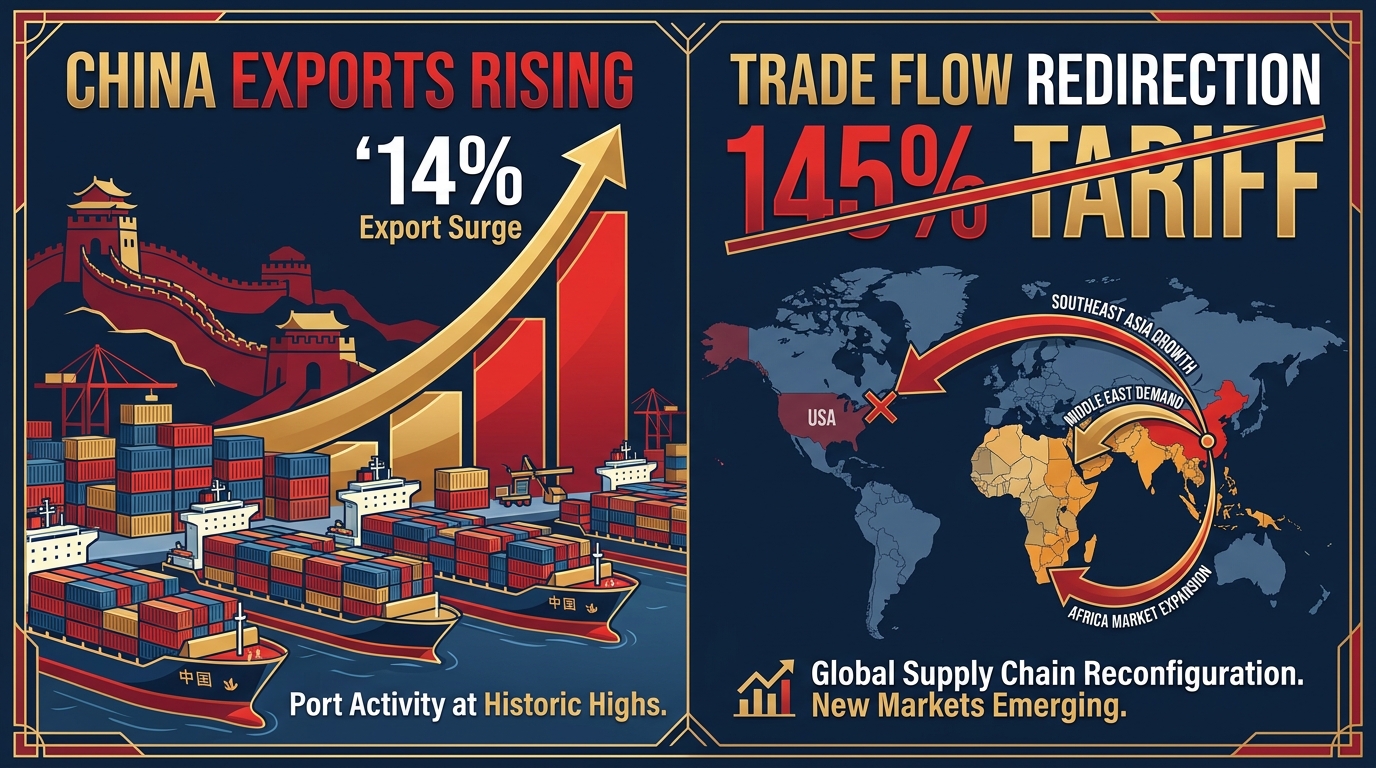
The United States has imposed tariffs of more than 145% on a broad range of Chinese goods. That is not a typo. For every $100 of Chinese products entering America, importers now pay over $145 in additional taxes. Most economists predicted these measures would sharply reduce Chinese exports. The data says otherwise. China's exports grew 14% year-over-year in April 2026, posting one of the strongest monthly surges in recent years. The question worth asking is: how?
미국은 중국 상품의 광범위한 품목에 145% 이상의 관세(tariff)를 부과했습니다. 오타가 아닙니다. 미국에 들어오는 중국 제품 100달러마다 수입업자는 145달러 이상을 추가 세금으로 납부합니다. 대부분의 경제학자들은 이 조치가 중국 수출을 급격히 줄일 것이라고 예측했습니다. 그러나 데이터는 다른 이야기를 합니다. 중국의 수출은 2026년 4월 전년 대비 14% 증가하며 최근 몇 년간 가장 강력한 월간 급등 중 하나를 기록했습니다. 물어볼 가치가 있는 질문은 이것입니다. 어떻게?
How Trade Diversion Works
The first explanation is what economists call trade diversion. When the US makes Chinese goods too expensive to import through tariffs, China does not simply stop exporting — it finds new buyers. Over the past 18 months, China has aggressively expanded trade relationships with Southeast Asia, the Middle East, Africa, and Latin America. Goods that once flowed to Los Angeles now arrive in Jakarta, Dubai, or São Paulo. The global market for Chinese manufacturing did not shrink. It just rerouted. Trade diversion is not new — it has happened before in economic history. But what makes China's case remarkable is the scale and speed of the adjustment. China manufactures roughly 28% of the world's goods by value. That level of manufacturing capacity does not disappear because one country imposes tariffs. It adapts. Chinese factories have also shifted toward higher-value products — semiconductors, electric vehicles, and industrial equipment — that face fewer restrictions and carry stronger margins. A trade surplus occurs when a country exports more than it imports. China has maintained a massive trade surplus with the United States for decades, and despite tariffs, that surplus has barely narrowed. In February 2026, China's trade surplus with the US was still approximately $32 billion — only modestly below its pre-tariff levels. This persistent surplus is a key source of tension heading into the Xi-Trump summit, because it means American consumers and businesses are still fundamentally dependent on Chinese goods, even at elevated prices.
첫 번째 설명은 경제학자들이 무역 전환(trade diversion)이라고 부르는 현상입니다. 미국이 관세로 중국 상품 수입을 너무 비싸게 만들면, 중국은 단순히 수출을 멈추지 않습니다. 새로운 구매자를 찾습니다. 지난 18개월 동안 중국은 동남아시아, 중동, 아프리카, 라틴아메리카와의 무역 관계를 공격적으로 확대했습니다. 한때 로스앤젤레스로 향하던 상품이 이제 자카르타, 두바이, 또는 상파울루에 도착합니다. 중국 제조업의 글로벌 시장은 줄어들지 않았습니다. 단지 경로를 바꿨을 뿐입니다. 무역 전환은 새로운 현상이 아닙니다. 경제사에서 이전에도 일어났습니다. 그러나 중국의 경우를 주목할 만한 점은 조정의 규모와 속도입니다. 중국은 금액 기준으로 전 세계 상품의 약 28%를 제조합니다. 한 나라가 관세를 부과한다고 해서 그 수준의 제조 역량(manufacturing capacity)이 사라지지 않습니다. 적응합니다. 중국 공장들은 또한 제한이 적고 마진이 강한 고부가가치 제품—반도체, 전기차, 산업용 장비—으로 전환해왔습니다. 무역 흑자(trade surplus)는 한 나라가 수입보다 수출이 많을 때 발생합니다. 중국은 수십 년간 미국과의 거대한 무역 흑자를 유지해왔으며, 관세에도 불구하고 그 흑자는 거의 줄어들지 않았습니다. 2026년 2월, 미국에 대한 중국의 무역 흑자는 여전히 약 320억 달러였습니다. 관세 부과 이전 수준에서 소폭 감소에 그쳤습니다. 이 지속적인 흑자는 시진핑-트럼프 정상회담을 앞두고 긴장의 핵심 원인입니다. 미국 소비자와 기업이 높아진 관세 가격에도 중국 상품에 근본적으로 의존하고 있다는 것을 의미하기 때문입니다.
What Summit Leverage Looks Like
Here is where geopolitical leverage becomes relevant. Leverage, in negotiation terms, is the ability to influence an outcome because you hold something the other side needs. China's export surge — happening right before the summit — is not accidental. It is a demonstration of strength. The message to Washington is clear: our economy is not collapsing under your tariffs. If anything, we are thriving. That changes the negotiating dynamic significantly. On the American side, the legal environment for tariffs is weakening. A US federal trade court has now struck down two separate rounds of broad measures imposed by the Trump administration, ruling that the executive branch exceeded its authority. These rulings do not immediately cancel existing tariffs, but they create mounting legal uncertainty. Every package is now subject to court challenge, which limits the administration's ability to threaten further escalation credibly. For businesses watching the summit, three scenarios are most likely. First, a partial deal: both sides announce reductions in some rates in exchange for Chinese commitments on intellectual property or market access. This is the "face-saving" outcome both governments want to show domestically. Second, a pause: no deal is reached, but both sides agree to freeze further escalation while talks continue — a truce that kicks difficult decisions down the road. Third, breakdown: talks collapse, tariffs escalate further, and global supply chains face another round of disruption. A third scenario — a managed retreat by both sides, in which the US selectively restores trade privileges in exchange for Chinese concessions on industrial subsidies — is considered most likely by the IMF, which has privately urged both governments to avoid the deeper that would permanently shrink global trade volumes. For South Korean companies sitting at the intersection of US and Chinese supply chains, each scenario carries materially different implications: a détente would ease dual-compliance costs, while deeper escalation could force Korean manufacturers to formally choose which market to optimize their production for. The Korean government has been careful to avoid appearing aligned with either side, but the Ministry of Trade, Industry and Energy has quietly begun stress-testing what happens to Korea's semiconductor export revenues if either the US or China implements secondary sanctions targeting Korean firms that supply the other side.
바로 여기서 지정학적 레버리지(geopolitical leverage)가 관련성을 갖게 됩니다. 협상 용어로 레버리지는 상대방이 필요로 하는 것을 보유하고 있기 때문에 결과에 영향을 미칠 수 있는 능력입니다. 중국의 수출 급증이 정상회담 직전에 일어나고 있는 것은 우연이 아닙니다. 강함의 과시입니다. 워싱턴에 보내는 메시지는 명확합니다. 우리 경제는 당신들의 관세 아래 무너지지 않고 있습니다. 오히려 번영하고 있습니다. 이는 협상 역학을 상당히 변화시킵니다. 미국 측에서는 관세에 대한 법적 환경이 약화되고 있습니다. 미국 연방 무역법원이 트럼프 행정부가 부과한 두 개의 별도 광범위한 관세 조치를 잇따라 무효화하며, 행정부가 권한을 초과했다고 판결했습니다. 이 판결들이 기존 관세를 즉시 취소하는 것은 아니지만, 점증하는 법적 불확실성(legal uncertainty)을 만들어냅니다. 모든 관세 패키지가 이제 법원의 도전을 받을 수 있으며, 이는 행정부가 추가 확대를 신뢰성 있게 위협하는 능력을 제한합니다. 정상회담을 주시하는 기업들에게 가장 가능성 있는 시나리오는 세 가지입니다. 첫째, 부분 합의입니다. 양측이 지식재산권이나 시장 접근에 관한 중국의 약속을 대가로 일부 관세율 인하를 발표합니다. 이는 양국 정부가 국내에서 보여주고 싶은 '체면을 살리는' 결과입니다. 둘째, 휴전입니다. 합의는 이루어지지 않지만, 양측이 협상을 계속하는 동안 추가 확대를 동결하기로 합의합니다. 어려운 결정을 미루는 휴전입니다. 셋째, 결렬입니다. 회담이 결렬되고, 관세가 더욱 확대되며, 글로벌 공급망이 또 한 차례 혼란에 직면합니다. 세 번째 시나리오 — 미국이 산업 보조금에 대한 중국의 양보를 대가로 무역 특권을 선택적으로 회복하는 양측의 관리된 후퇴 — 는 IMF가 가장 가능성 높은 것으로 보고 있어요. IMF는 세계 무역량을 영구적으로 줄일 더 깊은 디커플링을 피하도록 양국 정부에 비공개로 촉구했어요. 미국과 중국 공급망 교차점에 있는 한국 기업들에게, 각 시나리오는 실질적으로 다른 시사점을 가져요. 화해는 이중 규정 준수 비용을 줄이는 반면, 더 깊은 관세 에스컬레이션은 한국 제조업체들이 어느 시장을 위해 생산을 최적화할지 공식적으로 선택하도록 강요할 수 있어요. 한국 정부는 어느 쪽에도 정렬된 것처럼 보이지 않도록 주의해왔지만, 산업통상자원부는 미국이나 중국이 상대방에 공급하는 한국 기업을 겨냥한 세컨더리 제재를 시행할 경우 한국의 반도체 수출 수입에 어떤 일이 일어나는지 조용히 스트레스 테스트를 시작했어요.
The bigger picture
The concept of — the idea that the US and Chinese economies should separate their supply chains, technology systems, and financial ties — has been a policy goal in Washington for several years. But China's 14% export surge reveals a hard truth about : it is far easier to announce than to achieve. American companies have spent billions trying to diversify away from China, but the manufacturing scale, logistics infrastructure, and cost base that China offers remains unmatched in most sectors. , a word you will often hear in business contexts, refers to the process of sourcing and purchasing goods and materials that a company needs to operate. Global teams at major corporations are now facing an uncomfortable calculation: do they absorb higher costs to maintain Chinese supply chains, or do they pay the premium of shifting production to Vietnam, India, or Mexico? Neither option is cheap. And China's continued export strength suggests the pressure to fully exit is not yet overwhelming. One sector where China's export dominance is accelerating rather than retreating is electric vehicles. Chinese automakers — led by BYD — are now exporting to over 70 countries. While the US and EU have imposed specific tariffs on Chinese EVs, the rest of the world is buying them at scale. This is significant for two reasons: first, it represents a shift from China exporting low-cost consumer goods to exporting high-technology products. Second, it shows that walls in some markets simply push Chinese goods toward other markets — often with lower purchasing power but higher growth rates. For investors, the export surge creates a nuanced picture. On one hand, Chinese manufacturers and exporters are clearly outperforming expectations. Companies with significant China exposure in their supply chains may face continued cost pressure from tariffs, even if Chinese production costs remain low. On the other hand, if the Xi-Trump summit produces even a modest reduction, the relief rally in markets with China exposure could be substantial. The summit outcome is now one of the most closely watched near-term catalysts in global markets. Whether you manage a supply chain or simply follow trade news, the lesson from China's resilience is consistent: tariffs are a blunt instrument, and economic gravity tends to outlast political pressure when the two stay in conflict long enough.
디커플링(decoupling)—미국과 중국 경제가 공급망, 기술 시스템, 금융 관계를 분리해야 한다는 개념—은 몇 년간 워싱턴의 정책 목표였습니다. 그러나 중국의 14% 수출 급증은 디커플링에 대한 냉혹한 진실을 드러냅니다. 선언하기는 달성하기보다 훨씬 쉽다는 것입니다. 미국 기업들은 중국 의존도를 줄이기 위해 수십억 달러를 투자했지만, 중국이 제공하는 제조 규모, 물류 인프라, 비용 기반은 대부분의 분야에서 여전히 따라갈 수 없습니다. 기업 맥락에서 자주 듣게 되는 단어인 조달(procurement)은 회사 운영에 필요한 상품과 자재를 소싱하고 구매하는 과정을 의미합니다. 주요 기업들의 글로벌 조달팀은 이제 불편한 계산에 직면해 있습니다. 더 높은 관세 비용을 감수하며 중국 공급망을 유지할 것인가, 아니면 베트남, 인도, 멕시코로 생산을 이전하는 프리미엄을 지불할 것인가? 두 옵션 모두 저렴하지 않습니다. 그리고 중국의 지속적인 수출 강세는 완전한 탈출 압박이 아직 압도적이지 않다는 것을 시사합니다. 중국의 수출 지배력이 후퇴하는 것이 아니라 가속화되고 있는 한 분야는 전기차(EV)입니다. BYD가 이끄는 중국 자동차 제조업체들은 현재 70개국 이상에 수출하고 있습니다. 미국과 EU가 중국산 EV에 특정 관세를 부과했지만, 세계 나머지 지역은 대규모로 구매하고 있습니다. 이는 두 가지 이유에서 중요합니다. 첫째, 중국이 저비용 소비재 수출에서 고기술 제품 수출로 전환하고 있음을 나타냅니다. 둘째, 일부 시장의 관세 장벽이 중국 상품을 다른 시장—흔히 구매력은 낮지만 성장률은 높은—으로 밀어낼 뿐이라는 것을 보여줍니다. 투자자들에게 수출 급증은 미묘한 그림을 만들어냅니다. 한편으로, 중국 제조업체와 수출업체들은 기대를 분명히 뛰어넘고 있습니다. 공급망에서 중국 노출이 큰 기업들은 중국 생산 비용이 낮게 유지되더라도 관세로 인한 지속적인 비용 압박에 직면할 수 있습니다. 다른 한편으로, 시진핑-트럼프 정상회담이 소폭의 관세 인하라도 성사시킨다면, 중국 노출이 있는 시장에서 반등 랠리가 상당할 수 있습니다. 정상회담 결과는 이제 글로벌 시장에서 가장 주목받는 단기 촉매제 중 하나가 됐습니다. 공급망을 관리하든, 무역 뉴스를 따라가든, 중국의 탄력성에서 여러분이 얻을 수 있는 교훈은 일관돼요. 관세는 무딘 도구이고, 경제적 중력은 둘 사이의 갈등이 충분히 오래 이어질 때 정치적 압력보다 오래 버티는 경향이 있어요.
이 칼럼이 마음에 드셨나요?
새 칼럼이 발행되면 영문 + 한글 본문을 통째로 메일로 보내드려요. 매일 아침, 광고 없이.
언제든 한 번에 해지할 수 있어요.