Health Tech2026.05.10
Your Smartwatch Can Now Screen for an Invisible Stroke Risk
스마트워치로 뇌졸중 위험을 발견할 수 있게 됐다
읽기 도움말A Hidden Risk Most People Never Know They Have
Most people think of a stroke as something that arrives without warning. But in millions of cases, a hidden electrical problem in the heart has been silently raising the risk for months or even years — and most of those people never know it. On May 9, 2026, the U.S. Food and Drug Administration granted Samsung a new type of clearance for its Galaxy Watch 7 and Ultra series: the right to market the device as a screening tool for atrial fibrillation (AFib) in people who have no prior diagnosis and no obvious symptoms. This is the first time the FDA has allowed any wearable to make that specific claim. To understand why this clearance is significant, it helps to know what atrial fibrillation actually is — and why it is so dangerous.
대부분의 사람들은 뇌졸중이 아무런 경고 없이 찾아오는 것이라고 생각합니다. 그러나 수백만 명의 경우, 심장의 숨겨진 전기적 이상이 수개월 또는 수년 동안 조용히 위험을 높여 왔고 — 그 사람들 대부분은 그것을 전혀 모릅니다. 2026년 5월 9일, 미국 식품의약국(FDA)은 삼성의 갤럭시 워치 7 및 울트라 시리즈에 새로운 유형의 인가를 부여했습니다. 사전 진단이나 명백한 증상이 없는 사람들을 대상으로 심방세동(AFib) 스크리닝 도구로 기기를 마케팅할 수 있는 권한입니다. FDA가 어떤 웨어러블에도 그 특정 주장을 허용한 것은 이번이 처음입니다. 이 인가가 왜 중요한지 이해하려면, 심방세동이 실제로 무엇인지 — 그리고 왜 그것이 그토록 위험한지 — 알면 도움이 됩니다.
What Atrial Fibrillation Does to the Heart
The heart beats because of a carefully coordinated electrical that tells each chamber to contract at the right moment. In atrial fibrillation, that becomes chaotic. The two upper chambers of the heart — the atria — quiver rapidly and irregularly instead of pumping in a smooth rhythm. Blood pools in corners of the atria, and when blood sits still, it can form clots. If a clot travels to the brain, it blocks blood flow: that is a stroke. The most alarming fact about AFib is that it often produces no symptoms at all. No chest pain, no dizziness, no irregular heartbeat that a person can feel. Researchers estimate that approximately 12 million Americans have undiagnosed AFib — meaning they carry a fivefold elevated stroke risk and have no idea. Globally, AFib affects over 59 million people. The standard way to detect AFib is an (ECG) — a test that records the heart's electrical activity through sensors placed on the chest, arms, and legs. ECGs are accurate, but they require a visit to a clinic or hospital, and they only capture what the heart is doing during the few minutes of the recording. A person with intermittent AFib may appear completely normal during those minutes.
심장은 각 방이 올바른 순간에 수축하도록 지시하는 세심하게 조율된 전기 신호 때문에 뛰게 됩니다. 심방세동에서 그 신호는 혼돈스러워집니다. 심장의 두 개의 위쪽 방인 심방(atria)이 부드러운 리듬으로 펌핑하는 대신 빠르게 불규칙하게 떨립니다. 혈액이 심방 구석에 고이고, 혈액이 고여 있으면 혈전이 형성될 수 있습니다. 혈전이 뇌로 이동하면 혈류를 차단합니다. 이것이 바로 뇌졸중입니다. AFib에 대한 가장 놀라운 사실은 종종 아무런 증상도 일으키지 않는다는 것입니다. 흉통도, 어지럼증도, 느낄 수 있는 불규칙한 심박수도 없습니다. 연구자들은 약 1,200만 명의 미국인이 미진단 AFib를 갖고 있다고 추정합니다 — 즉, 그들은 뇌졸중 위험이 다섯 배 높은 상태로 아무것도 모르고 있습니다. 전 세계적으로 AFib는 5,900만 명 이상에게 영향을 미칩니다. AFib를 감지하는 표준 방법은 심전도(ECG)입니다 — 가슴, 팔, 다리에 부착된 센서를 통해 심장의 전기 활동을 기록하는 검사입니다. 심전도는 정확하지만 진료소나 병원을 방문해야 하며, 기록하는 몇 분 동안 심장이 하는 것만 포착합니다. 간헐적 AFib를 가진 사람은 그 몇 분 동안 완전히 정상으로 보일 수 있습니다.
How a Watch Generates a Medical-Grade ECG
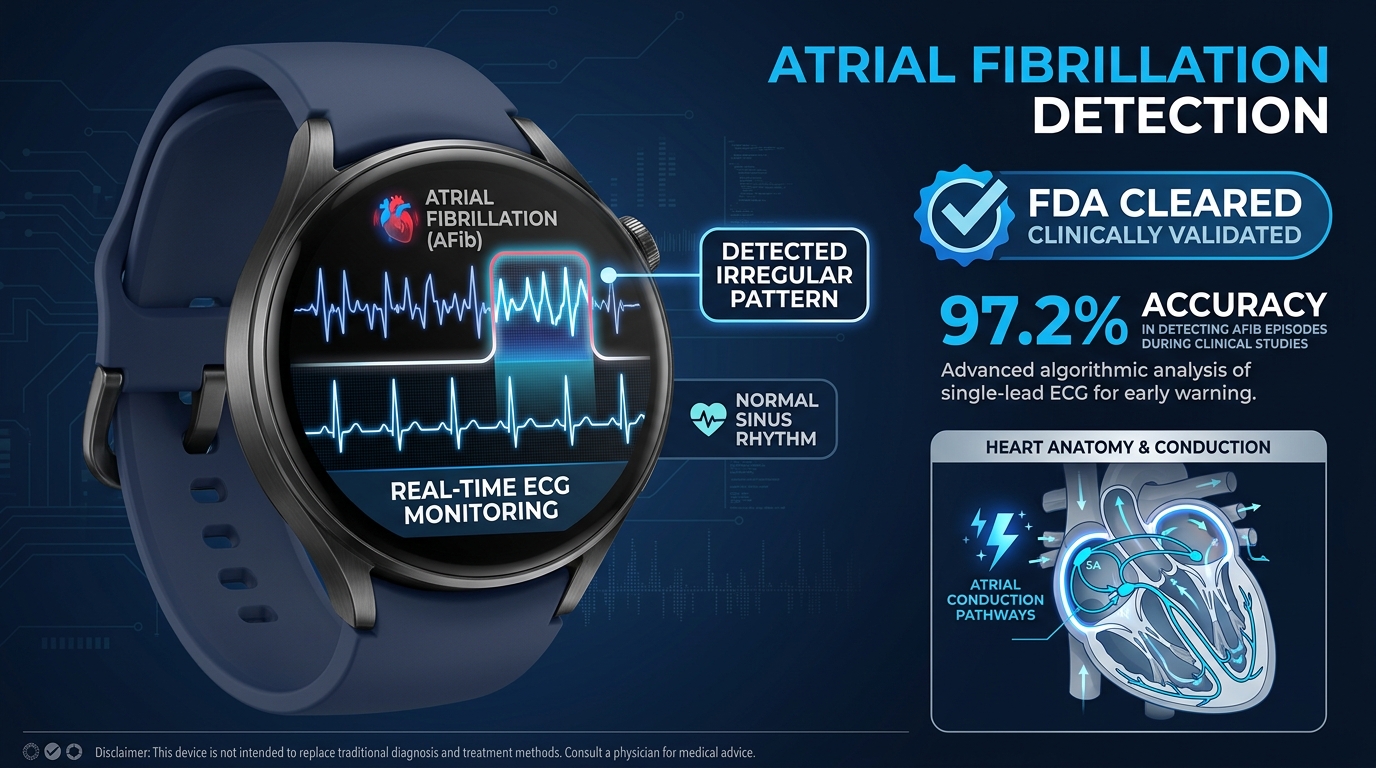
Samsung's Galaxy Watch 7 takes a different approach. When a user presses two fingers on the watch's back sensor for thirty seconds, the device generates a single-lead ECG using optical and electrical sensors embedded in the watch face. An algorithm developed in collaboration with the Mayo Clinic — trained on 1.4 million ECG segments — analyzes the resulting electrical trace in real time. The clinical validation study enrolled 4,800 participants and measured how often the algorithm correctly identified AFib when it was present () and how often it correctly ruled it out when it was absent (). The results: 97.2% and 94.8% . In clinical cardiology, that performance is considered excellent for a screening tool — comparable to a 12-lead ECG for detecting paroxysmal, or on-off, AFib.
삼성의 갤럭시 워치 7은 다른 접근 방식을 취합니다. 사용자가 30초 동안 워치 뒤면 센서에 두 손가락을 누르면, 기기가 워치 페이스에 내장된 광학 및 전기 센서를 사용하여 단일 유도 심전도를 생성합니다. 메이요 클리닉과 협력하여 개발된 알고리즘 — 140만 개의 심전도 세그먼트로 훈련된 — 이 실시간으로 생성된 전기 추적을 분석합니다. 임상 검증 연구는 4,800명의 참가자를 등록하고, AFib가 있을 때 알고리즘이 얼마나 자주 정확하게 AFib를 식별했는지(민감도)와 AFib가 없을 때 얼마나 자주 정확하게 배제했는지(특이도)를 측정했습니다. 결과: 민감도 97.2%, 특이도 94.8%. 임상 심장학에서 이 성능은 스크리닝 도구로서 탁월한 것으로 간주되며, 발작성 AFib 또는 간헐적 AFib 감지를 위한 12유도 심전도와 비교할 수 있습니다.
Why This Clearance Goes Further Than Apple Watch
What makes this FDA clearance different from what Apple Watch already has is the specific intended use. Apple Watch received clearance in 2018 and 2019 for detecting AFib in people who already have irregular rhythm notifications — meaning the algorithm alerts someone who is already showing a sign that something might be wrong. Samsung's new clearance allows the watch to be used proactively, as a periodic population screening tool, in people with no symptoms and no prior warning. This distinction matters enormously in practice. It means Samsung can now directly recommend that any Galaxy Watch user perform a periodic ECG check — not just people who already suspect a problem. Cardiologists estimate that population-level passive AFib screening with wearables could prevent approximately 150,000 strokes annually in the United States alone, by enabling early detection and prescription of medications that prevent clot formation. The scale of Samsung's potential reach makes this number plausible. Galaxy Watch currently has 48 million active users worldwide. If even a fraction of those users regularly use the ECG feature and share results with their physicians, the public health impact could be substantial. For context, the average annual number of strokes in the United States is approximately 800,000, making AFib-related strokes — about 15 to 20 percent of the total — one of the most preventable categories.
이 FDA 인가가 애플 워치가 이미 보유한 것과 다른 점은 구체적인 사용 목적에 있습니다. 애플 워치는 이미 불규칙한 리듬 알림을 받는 사람들, 즉 이미 무언가 잘못될 수 있다는 징후를 보이는 누군가에게 알고리즘이 경고하는 AFib 감지에 대해 2018년과 2019년에 인가를 받았습니다. 삼성의 새 인가는 증상도 없고 이전 경고도 없는 사람들에게 정기적인 인구 스크리닝 도구로 워치를 능동적으로 사용할 수 있게 합니다. 이 구별은 실질적으로 매우 중요합니다. 이는 삼성이 이제 문제를 의심하는 사람뿐만 아니라 모든 갤럭시 워치 사용자에게 정기적인 심전도 검사를 직접 권장할 수 있다는 것을 의미합니다. 심장 전문의들은 웨어러블을 이용한 인구 수준의 수동적 AFib 스크리닝이 미국만에서 연간 약 15만 건의 뇌졸중을 예방할 수 있다고 추정합니다. 혈전 형성을 막는 항응고제의 조기 발견과 처방을 가능하게 함으로써 그렇게 할 수 있습니다. 삼성의 잠재적 도달 범위의 규모는 이 수치를 그럴듯하게 만듭니다. 갤럭시 워치는 현재 전 세계적으로 4,800만 명의 활성 사용자를 보유하고 있습니다. 그 사용자들 중 일부라도 정기적으로 심전도 기능을 사용하고 의사와 결과를 공유한다면, 공중 보건 영향은 상당할 수 있습니다. 참고로, 미국의 연간 평균 뇌졸중 수는 약 80만 건으로, AFib 관련 뇌졸중 — 전체의 약 15~20% — 은 가장 예방 가능한 범주 중 하나입니다.
Samsung's Strategic Win — and the AI Behind the Algorithm
For Samsung, the clearance is also a strategic victory. The company has been competing aggressively with Apple in the digital health wearables market, where Apple Watch's reputation for medical-grade features has been a key selling point. The AFib screening clearance — which goes beyond what Apple Watch is currently authorized to claim — gives Samsung's health team a concrete and verifiable advantage in a feature category that resonates deeply with consumers over 40. The development of the algorithm itself reflects how deeply artificial intelligence has become embedded in medical device engineering. The Mayo Clinic collaboration involved training a convolutional neural network on 1.4 million labeled ECG recordings from the clinic's archive — one of the largest cardiology datasets in the world. The network learned to recognize the specific waveform irregularities that distinguish AFib from normal sinus rhythm, from premature beats, and from other arrhythmias that can mimic AFib's appearance.
삼성에게 이번 인가는 전략적 승리이기도 합니다. 회사는 애플 워치의 의료급 기능 평판이 핵심 판매 포인트였던 디지털 헬스 웨어러블 시장에서 애플과 적극적으로 경쟁해 왔습니다. AFib 스크리닝 인가 — 현재 애플 워치가 주장할 수 있도록 인가받은 범위를 넘어서는 — 는 40세 이상의 소비자들에게 깊이 공감되는 기능 범주에서 삼성 헬스 팀에게 구체적이고 검증 가능한 이점을 부여합니다. 알고리즘 자체의 개발은 인공지능이 의료기기 엔지니어링에 얼마나 깊이 내재되었는지를 반영합니다. 메이요 클리닉과의 협업은 클리닉 아카이브에서 140만 개의 레이블된 심전도 기록 — 세계에서 가장 큰 심장학 데이터셋 중 하나 — 으로 합성곱 신경망(convolutional neural network)을 훈련하는 것을 포함했습니다. 네트워크는 AFib를 정상 동성 리듬, 조기 박동, 그리고 AFib의 모양을 모방할 수 있는 다른 부정맥과 구별하는 특정 파형 불규칙성을 인식하는 법을 학습했습니다.
What Happens After a Positive Screen
Not everyone is celebrating the clearance without reservation. Some cardiologists have raised concerns about what happens after a positive screen. If 48 million watch users begin regularly testing for AFib and a small percentage receive positive results — even at 94.8% , that means roughly 5 in 100 negative cases are incorrectly flagged — the healthcare system could face a significant influx of patients seeking follow-up diagnostic ECGs and specialist consultations. In regions with already-strained cardiology capacity, this surge could overwhelm appointment availability. Samsung has anticipated this concern. The Galaxy Watch algorithm includes a confidence score alongside each result, and the companion Samsung Health app is programmed to recommend physician follow-up only when the confidence score exceeds a defined threshold — a design choice intended to reduce the volume of borderline cases forwarded to healthcare providers. Whether this is sufficient to prevent healthcare system strain will depend on how widely the screening feature is used in practice.
모든 사람이 아무 조건 없이 이번 인가를 환영하는 것은 아닙니다. 일부 심장 전문의들은 양성 스크리닝 후 어떤 일이 일어나는지에 대한 우려를 제기했습니다. 4,800만 워치 사용자들이 정기적으로 AFib를 검사하기 시작하고 일부가 양성 결과를 받으면 — 특이도 94.8%에서도 음성 사례 100건 중 약 5건이 잘못 표시됩니다 — 의료 시스템은 후속 진단 심전도 및 전문의 상담을 원하는 환자들의 상당한 유입에 직면할 수 있습니다. 이미 심장학 용량이 부족한 지역에서는 이 급증이 예약 가용성을 압도할 수 있습니다. 삼성은 이 우려를 예상했습니다. 갤럭시 워치 알고리즘은 각 결과와 함께 신뢰도 점수를 포함하며, 동반 삼성 헬스 앱은 신뢰도 점수가 정의된 임계값을 초과할 때만 의사 후속 진료를 권장하도록 프로그래밍되어 있습니다 — 의료 제공자에게 전달되는 경계선 사례의 양을 줄이기 위한 설계 선택입니다. 이것이 의료 시스템 부담을 예방하기에 충분한지는 실제로 스크리닝 기능이 얼마나 광범위하게 사용되는지에 달려 있을 것입니다.
Anticoagulants — The Treatment Early Detection Makes Possible
For people diagnosed with AFib, the primary treatment is a class of medications called anticoagulants — blood thinners that prevent clots from forming in the pooled blood of the atria. Drugs like warfarin, apixaban, and rivaroxaban can reduce the risk of AFib-related stroke by 60 to 70 percent when taken consistently. The challenge has always been identifying the patients who need them before a stroke occurs. That is the gap that population-level wearable screening is designed to close.
AFib로 진단된 사람들에게 주된 치료법은 항응고제라고 불리는 약물 계열입니다 — 심방의 정체된 혈액에 혈전이 형성되는 것을 막는 혈액 희석제입니다. 와파린(warfarin), 아픽사반(apixaban), 리바록사반(rivaroxaban)과 같은 약물은 지속적으로 복용할 경우 AFib 관련 뇌졸중 위험을 60~70% 줄일 수 있습니다. 과제는 항상 뇌졸중이 발생하기 전에 이것이 필요한 환자를 식별하는 것이었습니다. 그것이 바로 인구 수준의 웨어러블 스크리닝이 채우도록 설계된 격차입니다.
Global Regulatory Ripple Effects
The FDA's decision may also influence how other health agencies around the world approach wearable medical devices. Regulatory bodies in the European Union, South Korea, and Japan are watching the FDA closely: the United States typically sets the benchmark for evidence standards that other markets subsequently adopt. South Korea's Ministry of Food and Drug Safety has been expanding its digital health device framework since 2024 and has already cleared Samsung Health Monitor for the ECG recording function — though the AFib screening indication will require a separate domestic review.
FDA의 결정은 전 세계 다른 보건 기관들이 웨어러블 의료기기를 다루는 방식에도 영향을 미칠 수 있습니다. 유럽연합, 한국, 일본의 규제 기관들은 FDA를 면밀히 주시하고 있습니다. 미국은 일반적으로 다른 시장들이 이후 채택하는 증거 기준의 기준을 설정합니다. 한국 식품의약처는 2024년부터 디지털 헬스 기기 프레임워크를 확장하고 있으며, 이미 심전도 기록 기능에 대해 삼성 헬스 모니터를 인가했습니다 — 다만 AFib 스크리닝 적응증은 별도의 국내 심사가 필요합니다.
Patient action
The broader implication of this clearance is what it says about the direction of preventive medicine. For decades, population-level health screening — for conditions like high blood pressure, diabetes, and certain cancers — has required people to visit a clinic, remember to schedule an appointment, and navigate a healthcare system that many find intimidating or inaccessible. Wearable continuous monitoring shifts the locus of screening from the clinic to the wrist, potentially reaching people who would never otherwise be tested. There are legitimate concerns about equity in this shift. Galaxy Watch 7 and Ultra models start at approximately $300, placing them out of reach for many lower-income populations who also tend to have higher rates of undiagnosed AFib and fewer visits to specialists. If wearable-based screening becomes the primary detection method, it may paradoxically widen health disparities rather than narrow them, as it concentrates the benefit among people who can afford the technology. Before you dismiss an AFib alert on your Samsung Galaxy Watch as a false alarm, show the notification to your doctor at your next visit — the FDA cleared this device for a reason, and wearable-detected irregular rhythms caught early have measurably better outcomes than those found after symptoms appear.
이번 인가의 더 넓은 함의는 예방 의학의 방향에 대해 무엇을 말하는지에 있습니다. 수십 년 동안 고혈압, 당뇨병, 특정 암과 같은 질환에 대한 인구 수준의 건강 검진은 사람들이 진료소를 방문하고, 예약을 기억하고, 많은 사람이 위협적이거나 접근하기 어렵다고 느끼는 의료 시스템을 탐색해야 했습니다. 웨어러블 연속 모니터링은 검진의 중심을 진료소에서 손목으로 이동시켜, 그렇지 않으면 결코 검사받지 않을 사람들에게 도달할 가능성이 있습니다. 이러한 변화에는 형평성에 대한 정당한 우려도 있습니다. 갤럭시 워치 7 및 울트라 모델은 약 300달러부터 시작하여, 미진단 AFib 비율이 더 높고 전문의 방문이 더 적은 경향이 있는 많은 저소득층 인구에게는 접근하기 어렵습니다. 웨어러블 기반 스크리닝이 주요 감지 방법이 된다면, 기술을 구입할 여유가 있는 사람들에게 혜택을 집중시킴으로써 건강 불평등을 줄이기보다 오히려 역설적으로 심화시킬 수 있습니다. 삼성 갤럭시 워치의 AFib 알림을 오경보로 무시하기 전에, 다음 진료 때 의사에게 그 알림을 보여주세요. FDA가 이 기기를 허가한 데는 이유가 있어요. 증거에 따르면 웨어러블로 조기 발견된 불규칙 리듬은 증상이 나타난 후 발견된 경우보다 여러분에게 측정 가능하게 더 나은 결과를 가져다줘요.
이 칼럼이 마음에 드셨나요?
새 칼럼이 발행되면 영문 + 한글 본문을 통째로 메일로 보내드려요. 매일 아침, 광고 없이.
언제든 한 번에 해지할 수 있어요.